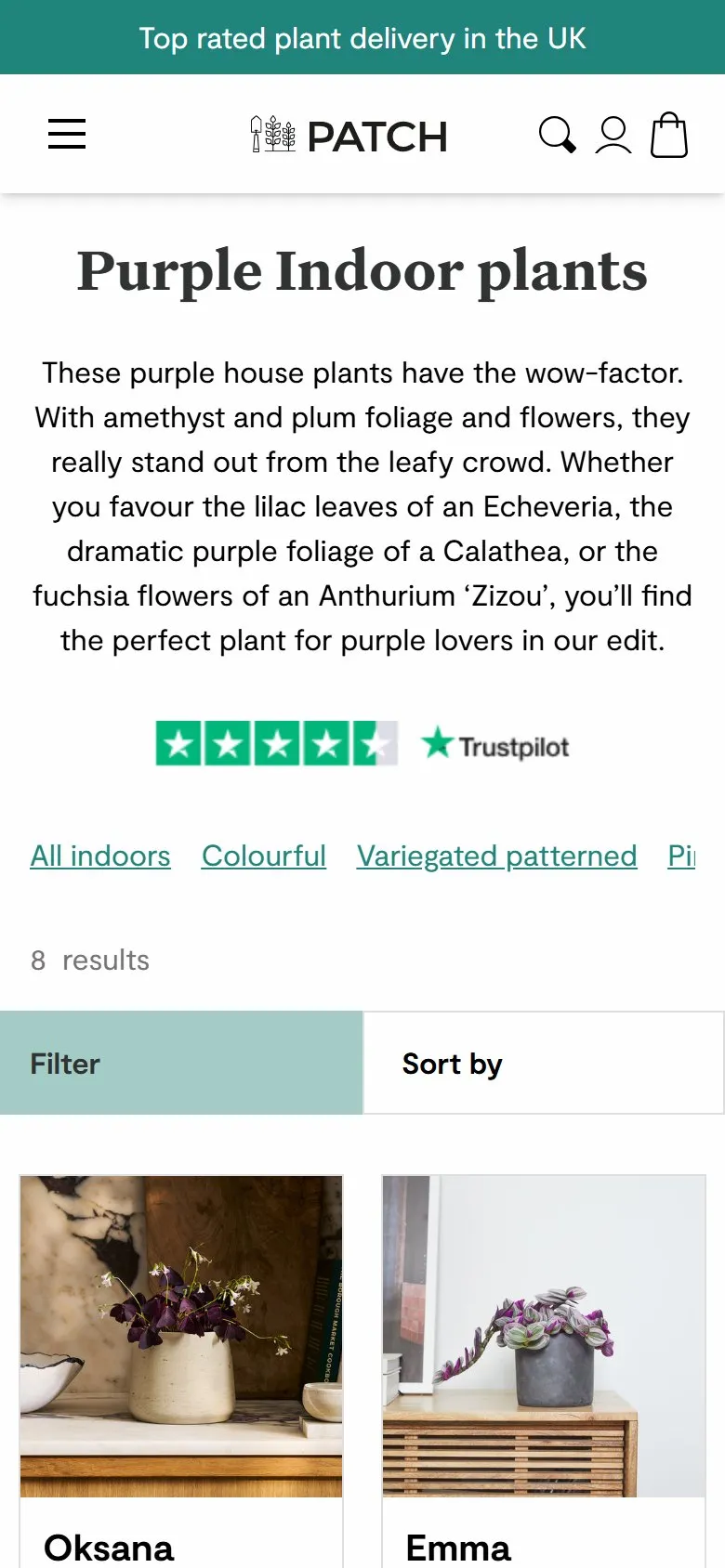
Collections named after the way people search, not the way plants are classified
What they do
As well as the usual plant-type collections, Patch builds collections around the words a shopper actually uses. "Almost unkillable indoor plants" holds 66 products, is titled "Unkillable Indoor Plants | Hardy House Plants Delivered" and gets its own homepage section ("We know what it's like to be guilty of plant murder"). There are collections by light ("Low Light Indoor Plants", 122 products), by room (bathroom, bedroom, living room) and by colour. The colour ones are the quiet performers. "Purple Indoor plants" is eight plants and a single paragraph, and SE Ranking's UK data (October 2026) has it at number one for "purple house plant" and a dozen ways of saying it, from "indoor plants with purple leaves" to "purple leaf houseplants". SE Ranking estimates that eight-product page brings in more search traffic than the bathroom plants collection. Red, pink and white have their own pages too, under a "Colourful" parent collection. The unkillable page sits second or third for "unkillable plants", "hardy indoor plant" and "indoor hardy plants".
Why it works
Nobody searches for "Sansevieria" when what they mean is "a plant I can't kill" or "something purple for the shelf". Each of these pages takes a filter value Patch already has (care level, light, colour) and gives it a real URL with its own title, H1 and a paragraph written for that search. A filtered grid on the main collection can't rank for "purple house plant". A page built for it can, and the purple one proves a big catalogue isn't needed to win: eight products and one good paragraph did it. The unkillable page earns its keep twice, because the same phrase works as a search target and as the reassurance a nervous first-time buyer is looking for.
Makes sense when
Your filters line up with phrases people genuinely search, and each page has enough products to be worth landing on. Check the search demand before building, write a short paragraph that's specific to the page rather than a template with the word swapped, and link to it from the main collection. Don't spin up a page for every filter combination: that's how a site fills up with thin, near-duplicate pages Google won't bother with.
The same search data can point at a gap in the range rather than a missing page. SE Ranking's UK figures put "black house plants" level with "colourful house plants" and ahead of "white indoor plants", which Patch already has a page for. But Patch doesn't stock a single black-leaved plant: "black" only appears in its indoor range as a pot colour. That's a buying decision before it's a page, and a good reason to show keyword research to whoever plans the range, not just the content team.
More like this
More collection patterns
Want this on your store?
I'll tell you which of these patterns will move organic revenue for your catalogue, and which to skip.
Book a discovery call