Before the build
A full crawl of the existing site, plus twelve months of performance data out of Google Search Console, so we know exactly which URLs earn traffic and revenue. That list becomes the thing the migration protects.
Most Shopify migrations lose organic traffic, not because Shopify is worse, but because nobody on the project owns SEO until it's too late.
Book a discovery callI've worked on close to 100 Shopify migrations agency side. I now come in alongside your build team as the SEO lead, so the rankings and revenue you've already paid for survive the move.
Because the SEO work happens too late, or not at all.
A migration is usually run by a design and build team, and they're good at design and build. The URL structure gets rethought because the new navigation calls for it. Collection pages get merged because there are too many. Old blog posts don't get carried over because nobody could see the point. Every one of those is a sensible decision in isolation, and together they delete the pages that were earning the money.
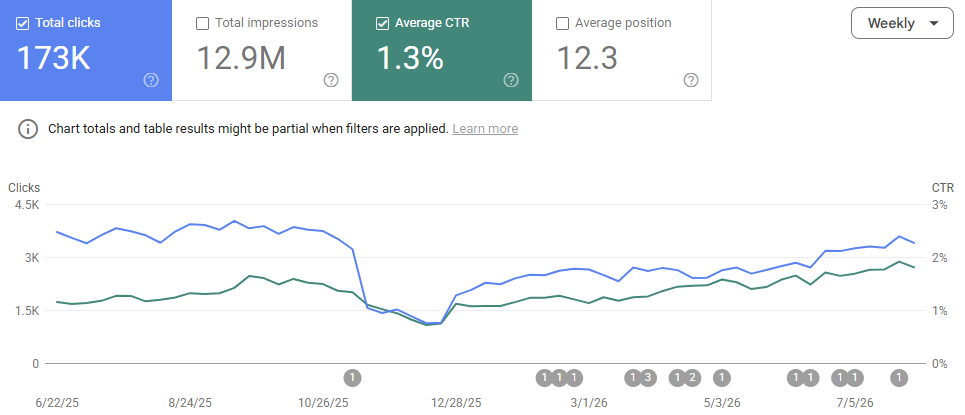
Then the site goes live, rankings drop, and the diagnosis starts three months later when the quarter's numbers come in.
The fix isn't complicated. It just has to happen before launch, and somebody has to own it.
I sit on the migration as the SEO lead, alongside whoever's building it.
That means being in the room when the URL structure gets decided, not after. It means having a mapped redirect file before launch rather than a scramble afterwards. It means knowing which of your pages actually earn organic revenue, so nobody bins them for being ugly.
A full crawl of the existing site, plus twelve months of performance data out of Google Search Console, so we know exactly which URLs earn traffic and revenue. That list becomes the thing the migration protects.
URL mapping and redirect rules, template-level SEO on the new theme, structured data, internal linking, and a check that the content actually made it across.
A staging crawl before you go live, then a live crawl after, indexing requests, and monitoring for the drops that need catching in days rather than months.
Tracking recovery against the pre-migration baseline, so you know whether it worked instead of hoping.
I've been building websites and doing SEO since 2010. Ten of those years were agency side, where I worked on close to a hundred Shopify migrations, before I set up on my own in 2025.
Clients over that time include Barbour, Montane, Buff, Yogamatters and Eribé. Big catalogues, long histories, the kind of sites where a migration done carelessly costs real money.
The volume matters more than any single name on that list. A hundred migrations is a hundred versions of the same few problems: the redirect nobody mapped, the collection structure that looked tidy and wasn't, the blog archive somebody decided wasn't worth moving. I've seen the ways these go wrong often enough to spot them in the planning stage rather than in the post-launch report.
Book a discovery call




Usually because the platform you're on has become the thing holding the business back. Self-hosted Magento and WooCommerce stores carry hosting, security and patching overhead that somebody has to own, and that somebody is normally expensive.
Shopify takes most of that off your plate, the checkout converts well, and the app ecosystem covers a lot of what you'd otherwise pay a developer to build. What Shopify won't do is improve your rankings on its own. That part comes down to how carefully the move is handled.
Lower maintenance overhead, predictable costs, a checkout that converts, and far less of your budget going on keeping the lights on.
For most mid-sized retailers the real gain is time: the hours currently spent on patching, hosting and bug fixes go back into merchandising and marketing instead. The trade-off is less control over URL structure and templating, which is exactly why the SEO side needs planning rather than assuming.
Most of the work is Magento, WooCommerce and BigCommerce moving to Shopify or Shopify Plus, plus Shopify-to-Shopify rebuilds where the theme changes but the domain doesn't.
The platform you're leaving matters less than how much organic traffic you've got to lose. A small catalogue on WooCommerce with fifty ranking pages is a simple enough job. A Magento store with fifteen years of category structure and thousands of indexed URLs is where the money gets lost, and where having someone own it pays for itself.
The two most common moves go wrong in different ways, and I've written both up. On a Magento to Shopify migration the risk is the category tree and the URL history sitting behind it. On a WooCommerce to Shopify migration it's usually the blog archive, which catches people out because it isn't the shop.
If you want the mechanics of how the data itself moves across, Shopify's own guide to migrating to Shopify is a decent starting point. It covers products, customers and orders. It doesn't cover what happens to your search rankings, which is the part this page is about.
Almost certainly. Shopify has a fixed URL structure, so products sit under /products/, collections under /collections/ and blog posts under /blogs/. Unless you go headless, a path like /womens/knitwear/aran-jumper isn't something you get to keep.
That matters less than it sounds, as long as every old URL is mapped to its closest match on the new site before you launch. What does real damage is treating a forced URL change as permission to rethink the whole architecture whilst you're at it.
So the job is rebuilding your existing structure inside Shopify's: the same category logic, the same depth, the same internal links pointing at the same places. Your site architecture and internal linking are ranking signals in their own right, and they're the part most migrations throw away without meaning to.
Only if the domain is changing. Change of Address in Search Console tells Google that one domain has moved to another, and it speeds up how quickly the new domain picks up the old one's signals. If you're rebranding or consolidating two sites, it's part of the launch plan.
If you're staying on the same domain and only the paths are changing, which is the usual Shopify migration, the tool doesn't apply and there's nothing to submit. Redirects do that work on their own. It's worth knowing which of the two you're doing, because it's a faff to unpick if the wrong thing goes in.
Some movement is normal. Google has to recrawl and reprocess the site, and that takes weeks rather than days. A short dip that recovers is a migration working as intended.
What isn't normal is a drop that doesn't come back. That's almost always redirects, either missing, chained, or pointing somewhere that doesn't match what the old page was about. Catching it in week one is a fix. Catching it in month three is a rebuild.
Start with a crawl and a Search Console export of the current site, so you know which URLs actually earn traffic rather than which ones look important. Map every one of those to its new destination.
Then keep the content that ranks, crawl staging before launch and the live site after, and request indexing on the pages that matter. None of it is complicated. It just has to happen before you go live rather than after.
Redirects done after launch instead of before. Changing URL structures without mapping them. Dropping blog content nobody could see the value of. Leaving the staging site indexable. Assuming the build team is handling SEO when nobody's actually been asked to.
I've written these up properly, along with what I do instead, in the Shopify migration mistakes that cost you organic traffic.
Depends what you've already got. If there's a build partner lined up, or an in-house team doing the build, a second agency isn't what's missing. What's missing is one person who owns search across the project and has the standing to say no in a planning meeting. That's the work I do most often.
A full-service agency makes sense if you want the store designed, built and migrated by one supplier. Worth checking whether the SEO work is genuinely in their scope with a name against it, or a line item nobody's been briefed on. It's the second one more often than anyone would like.
Not really, from a search point of view. Plus gives you more control over checkout, scripts and B2B, and Plus migrations tend to come with bigger catalogues and more legacy URLs. That raises the stakes rather than changing the method.
Where scale does change the job is redirects. Shopify's native URL redirects are literal and one-to-one, with no pattern matching. So a large migration needs a decided plan for how tens of thousands of rules actually get delivered, whether that's bulk import, an app, or a layer sitting in front of Shopify. That plan wants to exist before the URL structure is signed off, not during launch week.
The build sets the timeline, and my part runs alongside it rather than adding to it.
The one thing that does need protecting is the gap between the URL structure being finalised and the site going live. That's the window where redirect mapping happens, and compressing it is where mistakes get made. If the build team tells you the structure's locked two days before launch, that's the point to push back.
Agencies build good Shopify stores. That's a different job to protecting organic revenue, and on most migrations it's nobody's job at all.
My job on a migration is making sure the thing you're spending money on doesn't cost you the traffic you already had. Sometimes that means building the store myself. More often it means sitting alongside the agency you've picked as the person who owns search, which works whether you've chosen a build partner already or you're still deciding.
If you're just doing something for SEO, it's probably not worth doing. Migrations are the opposite: the SEO work is the bit that protects everything else. I covered a fair bit of this in my BrightonSEO masterclass on Shopify ecommerce SEO.
Full migration support starts from £2,500 + VAT. It's a fixed fee, usually over three to four months, and covers everything in the steps above: the crawl and data before the build, the redirect map, the checks either side of launch and the weeks of monitoring after. Bigger or older catalogues cost more, and you'll get a fixed quote before anything starts. If an agency's already handling the migration and you just want someone to check it over before launch, a pre-launch SEO check starts from £600 + VAT. Close to a hundred Shopify migrations and over 15 years in SEO means I know where these go wrong, and on a store doing decent organic revenue, a migration that loses it costs more than the fee within weeks.
Yes. I've built and launched Shopify stores including Eribé and Camden Fires, and I do a lot of ongoing Shopify theme development, most recently for Croft Mill. On larger migrations I'll often sit alongside an existing build team as the SEO lead instead, which works well when you've already got an agency in place. Either way the search side is owned rather than assumed.
Close to a hundred, mostly agency side over ten years, for clients including Barbour, Montane, Buff, Yogamatters and Eribé.
A fair share of the work arrives this way, and it's a different job to preventing it. It starts with reconstructing what the old site's URLs were, since that record is usually the thing nobody kept, then working out which of them were actually earning. After that it's redirects for the URLs worth saving, rebuilding the pages that were deleted and shouldn't have been, and getting the important templates crawled and indexed again. It takes longer than doing it properly the first time, and it's very rarely a write-off.
Usually a project fee that runs alongside the build, from planning through to a few weeks post-launch, since that's the window where the damage happens and gets caught. Some clients keep me on afterwards on a retainer to carry on the organic work once the site's stable. That's a separate conversation and not something you need to decide up front. Either way it starts with a look at what you've currently got to protect, then a fixed quote.
Book a discovery call and we'll look at what you've got to protect.
Book a discovery call
Start the conversation today
If you want more organic revenue out of your ecommerce store, send me a message and let’s talk.