Is AI content bad for SEO?
What Google's rules actually say about AI-written pages, product descriptions and posts, and the one thing that changed on 1 October 2026.
Jump to a section 8 sections
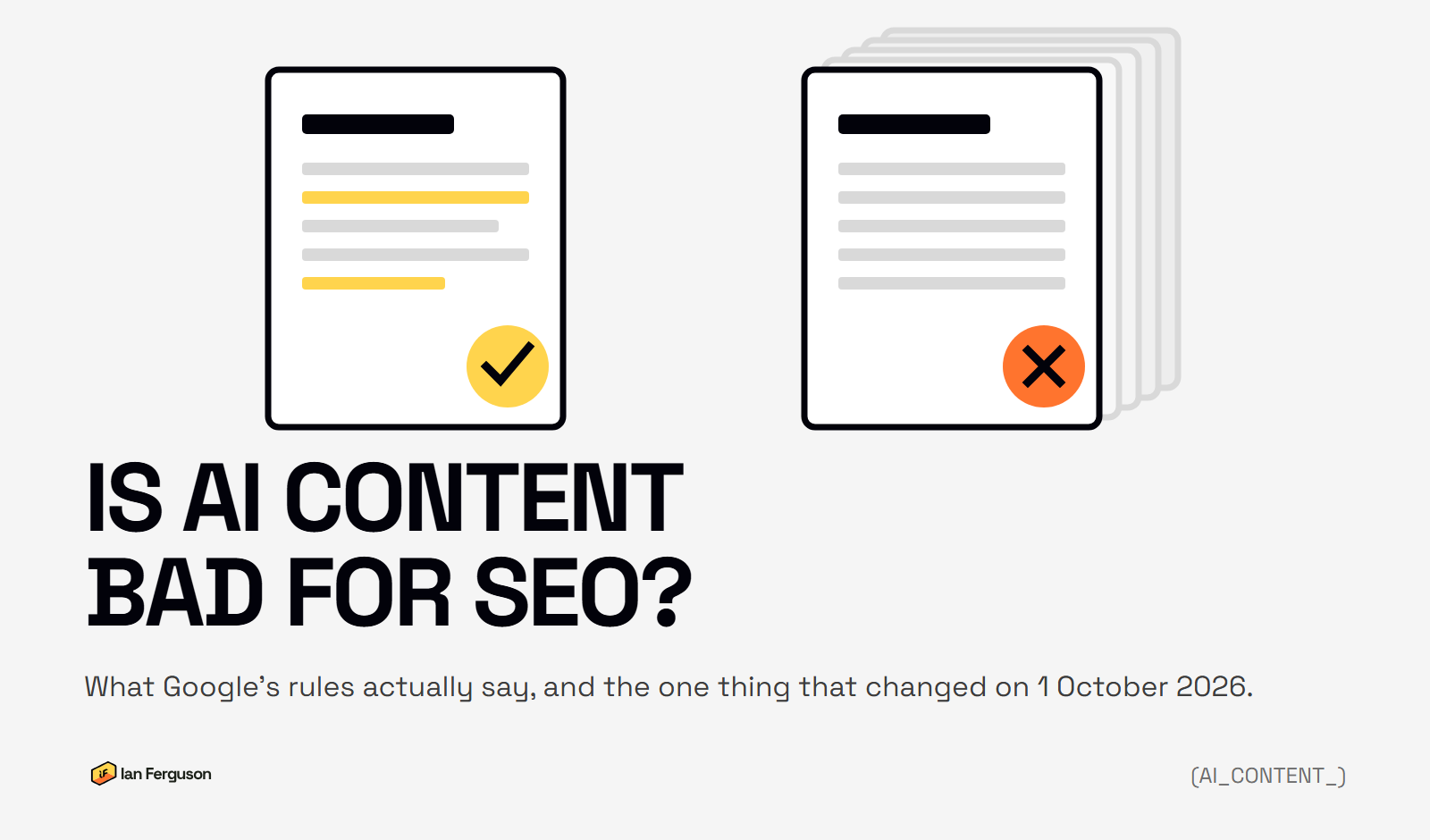
On 1 October 2026 Google added three sentences to its guidance on AI content, and the one that matters says it's "critical" that you fact-check every AI-written page before it goes live. If you've been told AI content gets your site penalised, or you've been using it and wondering whether you're about to be caught, here's what the rules say and what they don't.
TL;DR. AI content isn't against Google's rules and never has been. Two things are: churning out pages that add nothing, which has been a spam policy since March 2024, and publishing things that aren't true. Since 1 October Google says it's critical to fact-check every AI draft, titles and descriptions included, before it goes live. Use AI for the first draft, put what only you know into it, check it, and you're fine.
Does Google penalise AI content?
No. Google's own page on the subject, Guidance on using generative AI content on your website, opens by saying generative AI "can be particularly useful when researching a topic, and to add structure to original content". There's no ban, and there's no detector deciding whether a human typed it.
What there is, is a test. The same page says that if you're using AI content, "make sure your work meets the standards of the Search Essentials and our spam policies". Google's helpful content page puts the line in one sentence: "if you use automation, including AI-generation, to produce content for the primary purpose of manipulating search rankings, that's a violation of our spam policies."
So the question Google asks isn't "did a person write this?" It's "why does this page exist, and does it help the person reading it?" A product description written with AI and checked by someone who knows the product passes that test. Three hundred descriptions nobody read are the ones that may not.
What Google does penalise
One spam policy catches AI content, and one set of guidelines tells you what Google's raters mark as the worst of it. Neither mentions AI in the title.
Scaled content abuse. Added to the spam policies in March 2024. It covers generating many pages "for the primary purpose of manipulating search rankings and not helping users", and Google's AI guidance says bulk AI pages "without adding value for users may violate" it. AI, a template, a freelancer with a spreadsheet: the method doesn't matter. The purpose and the lack of value do. The version shops copy is a page per town, a page per colour, a page per "best X for Y", all written by nobody.
Content with no effort in it. This one isn't a penalty, it's a signal of what Google wants less of. The quality rater guidelines, which Google uses to check its ranking systems are working, give the lowest possible rating to pages where "all or almost all" of the content is "copied, paraphrased, embedded, auto or AI generated, or reposted from other sources with little to no effort, little to no originality, and little to no added value". That catches the supplier description run through a rewriter so it reads differently. Rewording isn't adding anything.
The example everyone remembers is the Amazon one. In January 2024 shoppers found listings for furniture and hose with names like "I'm sorry but I cannot fulfill this request it goes against OpenAI use policy", because sellers had pasted the chatbot's refusal straight into the product title. Futurism covered it and Amazon removed the listings. Nobody had read them.
What changed on 1 October 2026?
Google added three sentences to its AI content guidance on 1 October 2026, and they're worth quoting with the line that follows them:
"Keep in mind that generative models don't retrieve facts, but predict a likely sequence of words based on their training data. Because of this, generative AI outputs may contain inaccuracies (also known as hallucinations). It is critical to manually factcheck and review all AI-generated content for accuracy and trustworthiness before publishing. This review also applies to metadata like
<title>elements, meta description elements, structured data, and alternate texts for images, which can appear in Search results."
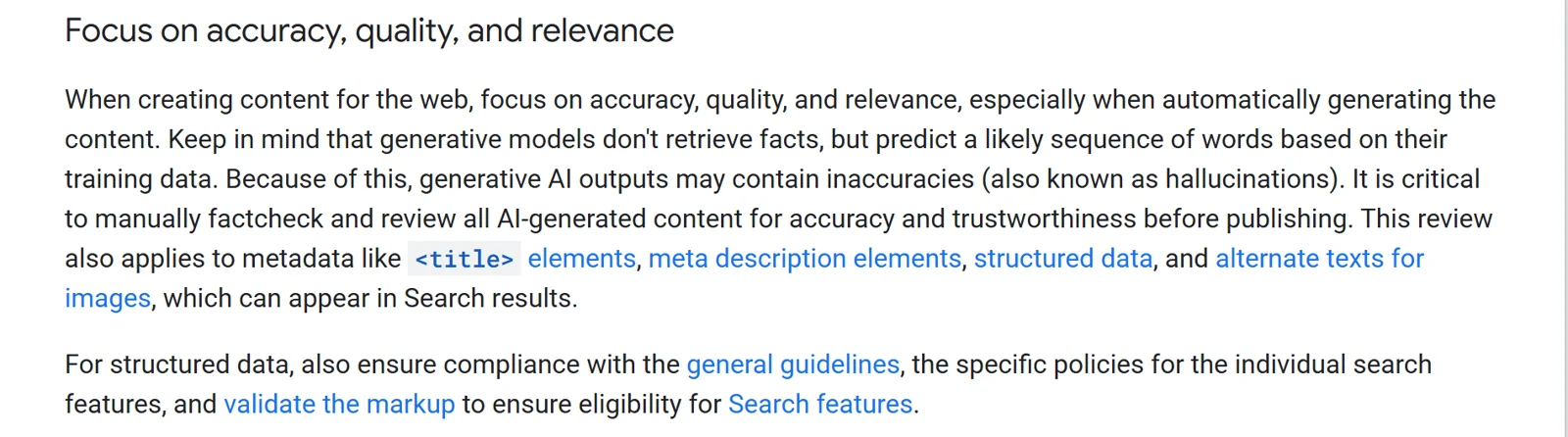
The new lines do two things. They name the problem, which is that these tools make things up, and they say the review covers the bits of a page most people never read back: the title tag, the meta description, the structured data and the alt text. Those are what Google shows in search results, so a made-up claim there is a made-up claim on Google's own page.
The reason it matters isn't theoretical. CNET corrected 41 of the 77 articles it published with an AI tool in 2023, over figures that looked fine and weren't. The ten-minute version of the check is in how to fact-check AI content before it goes on your site.
How Google's position on AI content has changed
Google's position on AI content has been more consistent than the headlines suggest. Four moments, from Google's own pages.
- 8 February 2023 · The first guidance
Google's blog post on AI content says it rewards quality "however it is produced", and that using automation to manipulate rankings is spam. The position hasn't moved since. - 5 March 2024 · Scaled content abuse becomes a spam policy
Many pages, little value, "no matter how it's created". Launched alongside the March 2024 spam update. - September 2025 · The rater guidelines raters use now
The current edition gives its lowest rating to pages made with "generative AI or otherwise" as a low-effort way to produce many pages, and to AI-paraphrased copies of other people's content. - 1 October 2026 · Fact-checking becomes "critical"
The AI content guidance page gains the three sentences above, and says the review covers titles, descriptions, structured data and alt text.
What's fine and what isn't
If you only read one bit of this, read the table.
| Fine | Not fine |
|---|---|
| An AI first draft of a product description, with your own knowledge of the product added and every claim checked | Three hundred product descriptions generated overnight that nobody has read |
| A blog post written from your answers to the questions AI asked you first | A blog post written from a one-line prompt, on a topic you know nothing about |
| Rewriting your own old copy to make it clearer | Running the supplier's description through a rewriter so it looks different |
| Using AI to plan the structure of a page, then writing it | A page per town or per colour, all the same, all written to catch a search |
| Title tags and descriptions you've read as a customer would | Title tags and descriptions generated in bulk and never opened |
| Product titles made with AI, labelled as such in Merchant Center | AI-made product titles sent to Merchant Center as if a person wrote them |
What this means for an online shop
Shops are where the rules bite, because shops have the most pages and the least time.
Product descriptions. The supplier's copy is on fifty other sites already. Paraphrasing it with AI makes it look different and adds nothing, which is exactly the rater guidelines' definition of the lowest rating. What's worth having is the thing only you know: how it fits, what it's like in the hand, which customers it suits, what goes wrong with it. Give that to the tool and let it do the typing.
Category page text. The three paragraphs under the product grid are the most common AI shortcut on shop sites, and the most pointless. If the text wouldn't help someone choose, it's there for Google, and Google has said what it thinks of that.
Google Shopping. This one's a rule, not a guideline. Merchant Center says that "all titles created using generative AI must be provided using the structured title attribute", marked as AI-made, and the same goes for descriptions. The title attribute page has the wording. In plain terms: if an app writes your product titles with AI, ask whoever runs it whether those titles go to Google labelled as AI-written. If they can't tell you, don't let the app write them.
Blog posts. The same test as everything else: would a customer be glad they read it, and is every claim in it true? A post that says what you'd say over the counter passes. A post about "10 tips for choosing a kitchen" that any joiner in the country could have published doesn't, whoever wrote it.
How do you use AI for content without the risk?
Four habits, and none of them slow you down much.
- Make it ask you first. Before it writes a word, have it ask what's different about the thing, who it's for and what you'd tell a customer. Your answers are the content.
- One page at a time. The moment you generate pages in bulk, you've stopped reading them, and unread bulk is what the spam policy describes.
- Check every number, name, claim and date. Against your own data or the official page, not against another AI.
- Read the title and description as a customer. They're the only bits of your page most people ever see, and since October they're explicitly part of the check.
Questions I get asked
Can Google tell if content was written by AI? It doesn't need to. The policies judge what the page does for the reader, not who typed it, so a detector score defends nothing either way.
Should I say on the page that AI was used? For a blog post it's your call. Google's helpful content page says disclosures are useful where readers might wonder how something was made. For product titles and descriptions in Google Shopping it isn't a choice: they have to be labelled.
Are AI product descriptions spam? No. Unchecked ones that copy the supplier are. The difference is whether a person who knows the product has read and improved them.
I published a lot of AI pages last year. Am I in trouble? Only if they're thin. Open ten at random and read them as a customer. If you'd be embarrassed, fix those pages properly or remove them. If they're genuinely useful, leave them alone.
Does Shopify's built-in AI count? Same rules. It's a first draft. Read it, correct it, add what you know, then publish.
If you run an ecommerce store and want more of this once a week, that's what Ecommerce Prioritised is for.
Written by
Ian Ferguson
UK-based ecommerce SEO consultant, helping online shops with the technical SEO and content that drive organic growth.
Get the next one in your inbox
Ecommerce Prioritised is a free weekly read on growing an ecommerce store: what to prioritise, what to ignore, and the changes worth acting on.
Filed in Google & Shopify updates
Share LinkedIn