Post-Migration SEO Recovery
The new site went live, the rankings dropped, and nobody on the project can tell you why. That's the job.
Book a discovery callA fair share of my work arrives after the launch rather than before it. Finding what a new build broke is a different job to preventing it, and it's very rarely a write-off.
Why does organic traffic drop after a website migration?
Because the new site is a different site, and Google is being asked to work that out on its own.
Most of the time it comes down to a short list. Old URLs that were never redirected, or were redirected to the homepage. Collection pages that were merged or renamed because the new navigation called for it. Blog posts nobody carried over. Filters generating thousands of thin pages the old site never had. A staging site that was left open to Google, or a live one that launched with a noindex tag still on it.
None of those is exotic. What makes recovery hard is that they all land at once, the old site is gone, and the people who built the new one have usually moved on to the next project. So the first job isn't fixing anything. It's reconstructing what you had.
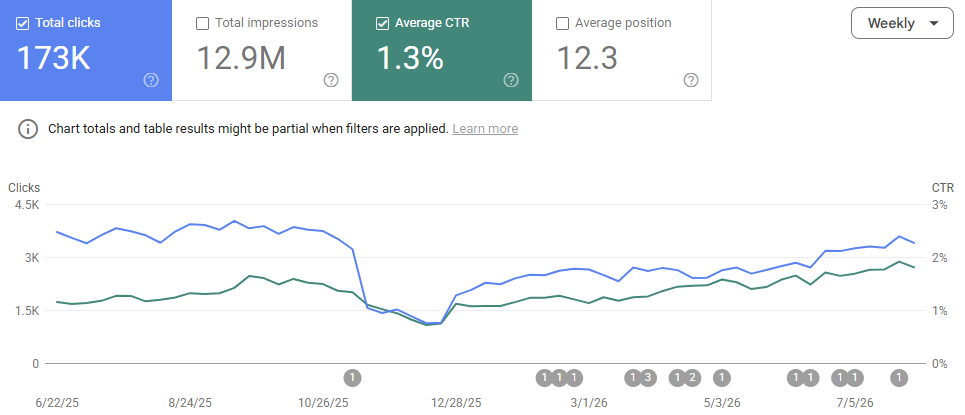
One fabric retailer I work with lost just over half of its non-brand clicks in the two months after a platform move. Within six months most of it was back, and the pages that recovered first were the ones where the fix was a redirect that should have existed on launch day.
How do you recover SEO after a migration?
In the order of what each problem is costing you, not in the order a checklist lists them.
(Step 01_) Reconstruct the old site
Twelve months of Search Console data from before the launch, so we know which URLs were earning and which weren't. Old crawls, old sitemaps, the Wayback Machine, whatever still exists. That record is usually the thing nobody kept, and it's the thing everything else depends on.
(Step 02_) Find what broke
Crawl the new site and match it against the old one, URL by URL. Which pages were earning and now return a 404. Which redirects go to the wrong place, or through three hops, or to the homepage. Which pages exist but have lost the content, the title or the internal links that made them rank. Then rank all of it by the clicks that sat on the old page.
(Step 03_) Fix the expensive things first
Redirects for the URLs worth saving. Rebuild the pages that were deleted and shouldn't have been. Get the templates that matter crawled and indexed again. Close the doors that were left open: filter URLs, staging, search result pages. Where I can make the change myself on Shopify I do, and where it needs your developer, you get a list they can act on without a second conversation.
(Step 04_) Measure the recovery properly
Non-brand clicks against the same window last year, split from brand, because the all-traffic figure hides what's actually happening. Then a check that nothing else changed in the same month, like a brand paid campaign going live or the analytics breaking. I've seen both get read as a migration problem when they weren't.
Who have you done this for?
Close to a hundred migrations agency side, and since then the recovery work on stores that launched without anyone owning search. The latest: a fabric retailer that lost just over half its non-brand clicks after a platform move and had most of it back within six months and nearly all of it within ten, at a better average position than the old site.
Search Console, UK, searches that don't include the brand name. The fabric retailer above: the site changed platform in November, bottomed out in December, and was back to 96% of the pre-migration quarter by the following summer, at a better average position.
- 96%
- of pre-migration non-brand clicks back within ten months of launch
- 10.5
- average Google position now, from 16 in the quarter before the move
- 100+
- migrations worked on, agency side
-

-

-

-

-

- and many more
What my clients say

“Ian joined Croft Mill at a really difficult point after our website migration and quickly became more like a member of our team than an external consultant.”
He has done a huge amount of work across both technical SEO and CRO, helping us identify and work through the issues left by the migration while also looking at how we can improve the website, customer journey and conversion. He works incredibly quickly, is very organised and proactive, and can turn complex problems into clear actions.
Post-migration recovery FAQs
How long does it take for rankings to recover after a website migration?
Weeks for the easy part, months for the rest. Once the redirects and the missing pages are fixed, Google usually reprocesses the important URLs within a few weeks, and you'll see the first movement in Search Console before you see it in sales.
Full recovery depends on what was lost. A site that only had a redirect problem can be back inside two months. One where collection pages were merged, content was deleted and the navigation changed is a longer job, because some of those pages have to be rebuilt rather than redirected. On the fabric retailer above, most of the non-brand traffic was back within six months, and the last stretch is still being worked on.
Is it normal for traffic to drop after a migration?
A short dip is normal. Google has to recrawl and re-evaluate the site, and that takes weeks rather than days. If you've changed URLs, even with perfect redirects, expect some movement.
What isn't normal is a drop that's still there eight weeks later, or one that's concentrated on a particular type of page: every collection, every blog post, every product in one brand. That shape is a diagnosis. It tells you something specific broke, and it's almost always fixable.
What are the most common things that break?
Redirects, first and by a distance. Either not done at all, done after launch instead of before, pointing at the homepage, or chained through two or three hops. On one site the seasonal pages that earned every Christmas were still on last year's URLs, with redirects pointing at products that had since been deleted.
After that: collection and category pages merged or renamed so the old ones return nothing. Blog archives left behind because nobody could see the point. Filtered URLs on the new platform creating thousands of thin pages. Metadata and structured data not carried across. And the odd one that's embarrassing but common, a noindex left on from staging or a robots.txt blocking the lot.
Can you fix a migration that went live months ago?
Yes, and it's most of what I see. The job is harder than it would have been at launch, because the old site has gone and Google has already started forgetting the old URLs, but the data is usually still there. Search Console keeps sixteen months of history, which is enough to rebuild the list of what was earning.
The further out you are, the more of the work becomes rebuilding rather than redirecting. A page Google dropped from the index a year ago has to earn its place back rather than just inherit it. That's still doable. It's just slower, and the sooner the first fixes go in, the less of it there is.
How do you know the migration caused the drop?
By checking what else changed. It's a fair question, and on more than one site the migration got the blame for something else. A brand paid campaign going live in the same month will take clicks that used to arrive free, and the organic line drops without anything being broken. Analytics breaking during the rebuild makes sessions fall whilst Search Console clicks stay flat. Bot traffic inflating the old numbers makes the new site look worse than it is.
So the first pass separates brand from non-brand, compares the same window year on year, and looks for anything that moved at the same time as the launch. Then we fix what the migration actually broke, rather than what it looks like it broke. If you suspect a Google update is in the mix, the Google penalty check on this site is a free fifteen-minute first pass you can run yourself.
We're on Shopify. Does that change anything?
It changes the fixes, not the diagnosis. Shopify's redirects are one-to-one with no pattern matching, so a large recovery needs a plan for how thousands of rules get loaded rather than typed in. Collections, filters and the way the platform handles out-of-stock products all have their own traps, and I know most of them from the inside because I build on Shopify as well as doing the SEO. Most of the recovery work I've done has been on Shopify stores, and I can make a lot of the changes myself rather than handing a list to your developer. Shopify SEO is its own page if you want the detail.
Why not just ask the agency that built it?
You can, and sometimes they'll fix it. But the people who built the site are rarely the right people to find what it broke.
A build team measures success by the site launching. Search is a different discipline, and on most projects nobody was asked to own it, so asking the same team to find what broke means asking them to audit their own work with the old site already gone. I come in as the person who owns search, works alongside whoever built it, and has no stake in the build being right.
How I work
What does post-migration recovery cost?
It starts with a diagnosis, which is a fixed fee from £600 + VAT and takes a couple of days. You get a written answer to what broke, what each problem is costing you, and what to fix in which order, with the evidence from your own Search Console data. If you want me to do the fixing, that's quoted separately once we know the size of it, usually as a project fee over a few months rather than an open-ended retainer. Some clients keep me on afterwards to carry on the growth work once the site's stable, which is a separate conversation.
Can you work alongside the agency that built the site?
Yes, and it usually works better that way. They know the build, I know what search needs from it, and the fixes land faster when nobody has to be defensive about the launch. I'm not there to apportion blame. I'm there to find the ten things that explain the drop and get them done.
What do you need from me to get started?
Access to Search Console and Google Analytics, and whatever you've still got from the old site: a crawl, a sitemap, an export, even a list of the pages you remember mattering. If there's nothing, that's fine, Search Console history and the Wayback Machine cover most of it. And the date the new site went live, which is harder to pin down than you'd think once a few months have passed.
What if it's not the migration?
Then you'll know that, which is worth having. The diagnosis looks at everything that changed in the same window, and if the drop turns out to be a paid campaign cannibalising brand traffic, a tracking problem or a Google update, I'll say so.
Should I wait and see if it recovers on its own?
A short dip does. A drop that's still there eight weeks after launch won't, and every week a page stays unredirected Google forgets a little more of what it knew about it. A month-three fix costs more than a week-one fix, and a year on it's a rebuild. The common versions are written up in the Shopify migration mistakes post further down this page, if you want to check your own site first.
Lost traffic since the new site launched?
Book a discovery call and we'll work out what broke, and what it's costing you.
Book a discovery call
Work with me
Start the conversation today
If you want more organic revenue out of your ecommerce store, send me a message and let’s talk.