AI Search Visibility (GEO)
Most of GEO is ecommerce SEO with a new name. Here's the part that isn't, and how to tell whether any of it is making you money.
Book a discovery callIf you're just doing something for AI, it's probably not worth doing. The work that gets a store cited is the work that gets it ranked and bought from: product data that says what the product is, collection pages that do their job, and answers to the questions your customers actually ask.
Why don't AI tools recommend your products?
Because there's nothing for them to retrieve.
An AI assistant answering "which kitchen tap for low water pressure" or "a dog harness that stops pulling" goes looking for pages that answer it: specific product data, real detail about what something is made of and who it's for, a collection page that explains the range rather than just listing it. Most stores have a product title, three bullet points and a size chart. There's nothing to cite, so the answer cites someone else.
With another client, orders started arriving through ChatGPT after a year of unglamorous work: every colourway split into its own product, titles rewritten to say what the product actually was, and structured data that was valid. Nobody wrote a line of it for AI. It was written for the customer, and the AI found it because it was there.
Most of what's being sold as GEO, AEO or LLM SEO is the old discipline with a new invoice. The genuinely new parts are narrower than they look, and they're about product data and measurement rather than magic.
What does AI search optimisation involve for a store?
Four things, in this order. Three of them are good ecommerce SEO. The fourth is how you tell whether it's working.
(Step 01_) Make the product data worth retrieving
Titles that say what the product is, not the internal name. Descriptions with the material, the fit and the use in them. Variants structured so each one can be found. Valid product structured data with price, availability and identifiers. On Shopify, agentic storefronts now hands that same data to ChatGPT, Gemini, Copilot and the rest by default, so whatever is thin on the product page is thin in the AI answer too.
(Step 02_) Get the collection pages right
This is the structural bit, and it's where the citations go. On one client's store, nine of the ten pages Google's AI answers cite most are collection pages, not blog posts. So: the right collections for the way people actually search, a short intro that explains the range, filters that help rather than spawn junk URLs, and internal links that tie the collections together. It's the same work that ranks them in Google.
(Step 03_) Answer the questions shoppers ask
Sizing, delivery, materials, whether you do trade orders. Answer them properly on your own site, near the product, where the customer and the crawler can both reach them, and check your robots.txt isn't blocking the AI crawlers by accident. On Shopify, the free Knowledge Base app shows you the questions shoppers are asking AI about your store that you haven't answered yet.
(Step 04_) Check the till first, then the tools
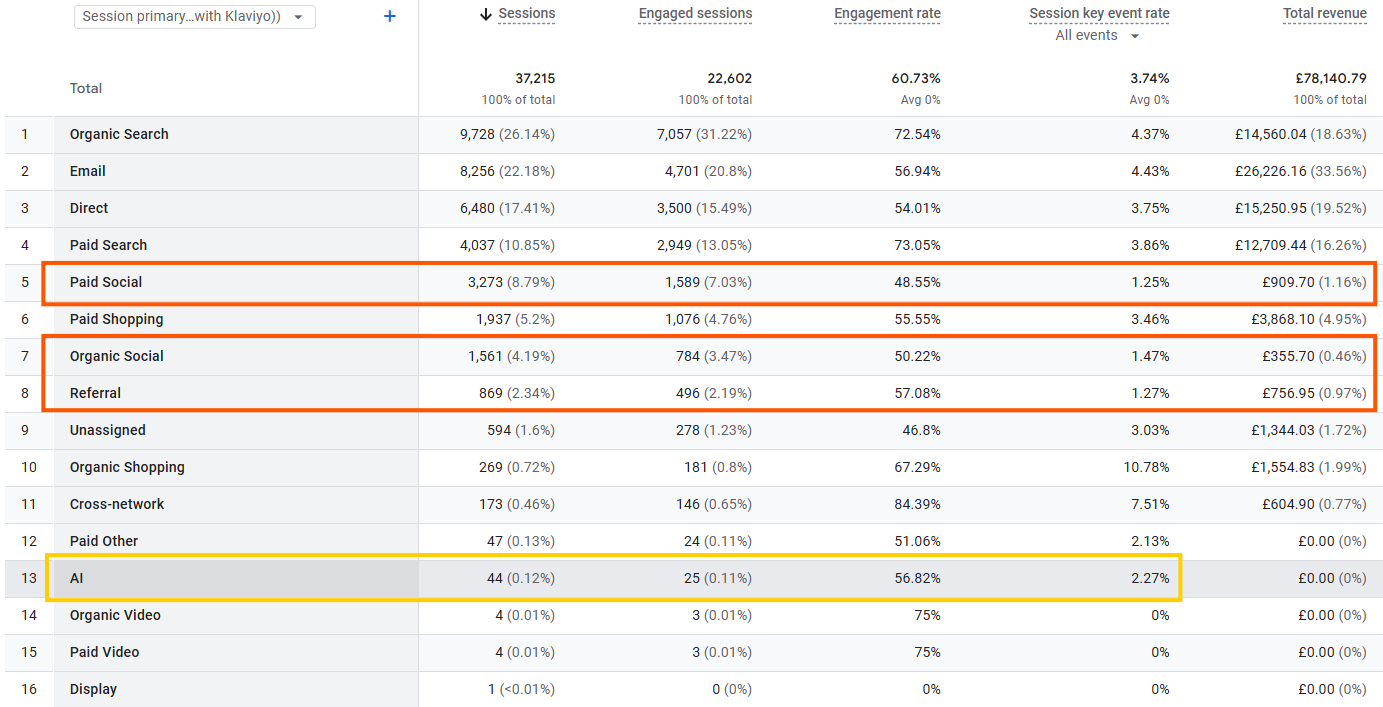
Revenue first: GA4's AI Assistant channel and Shopify's own agentic storefronts report show what AI actually sold. Then the diagnostics: Search Console for which pages Google's AI answers lift, SE Ranking for rankings and which searches now show an AI Overview, Waikay for how ChatGPT, Gemini, Claude and Perplexity describe you. They tell you where to look. They don't tell you what it's worth.
Can you show it working?
With one client I work with, nobody had touched the AI channels when I switched on Shopify's Knowledge Base app in May, and ChatGPT had already sent about £2,000 of orders in the six months since launch. In the last 30 days its agentic storefronts took £2,107, and the pages Google's AI answers lean on are the collection pages, which is ordinary structural SEO rather than anything written for AI.
Search Console's AI features report, 18 May to 16 October 2026, averaged per day because May and October are part months. Impressions only, with no clicks or queries, so it shows which pages Google's AI is reading, not what they earned. Sales are from Shopify's agentic storefronts report, last 30 days to 16 October.
- £2,107
- through agentic storefronts in the last 30 days: ChatGPT £1,148, Shop £763, Copilot £195
- 9 of 10
- of the pages Google's AI answers cite most on that store are collection pages
- 821k
- times Google's AI answers showed its pages since May. Seen, not bought, so it comes third
-

- and many more
What my clients say
“Ian is one of the most cheerful and happy SEO leaders I have had the privilege of meeting and working with.”
Read the full recommendationClose
SEO is pretty boring. There are no shortcuts. Onsite SEO requires diligent, meticulous - some might say boring - work. And like the painting of the Tyne Bridge - the job is never complete. He always has new ideas on how things can be improved. He works through the key factors for each keyword and focus area. And once that is done, he starts all over again.
AI search FAQs
What is generative engine optimisation?
Getting your products and content retrieved and cited by AI tools that write answers: ChatGPT, Google's AI Overviews and AI Mode, Perplexity, Gemini, and the shopping features inside them. It goes by a lot of names (AEO, LLM SEO, AI visibility) and they all mean roughly the same thing.
For a store, the practical version is: can an AI assistant find your product data, understand what the product is, cite your page when someone asks a question you answer, and send the customer to buy it.
How do I get my products into ChatGPT shopping?
On Shopify, through agentic storefronts, which is on by default for eligible stores and shares your catalogue with ChatGPT, Gemini, Copilot and Meta. You'll find it under Sales channels, Agentic. ChatGPT sends the customer to your own checkout to pay, so your payment methods and offers still apply. To sell through ChatGPT the store has to sell to US customers, though it can be based anywhere.
Being switched on isn't the hard part. What decides whether anything comes of it is the product data behind it: whether the titles, descriptions, attributes and structured data say enough for an assistant to match the product to a question. The same data feeds Google Shopping, so a clean product feed does double duty.
While you're in there, install Shopify's Knowledge Base app. The FAQs you add in it shape what AI tools say about your store, and it lists the questions shoppers asked that you couldn't answer. On the client above, the first unanswered questions were about wholesale orders and international shipping.
How do I track AI search traffic?
Since 13 May 2026, GA4 has an AI Assistant channel of its own, so ChatGPT, Gemini, Claude and the other big names no longer hide in Referral. It doesn't cover every assistant, and it doesn't help you compare with months before it existed, which is where a custom channel group still earns its keep. My guide to tracking AI traffic in GA4 walks through both. On Shopify, the agentic storefronts report shows the sales by AI channel.
Track it to stay informed, not to stay busy. For most stores AI is still a small slice of revenue, and the job is spotting where it's already sending people, not rebuilding the site around it.
Which tools do you use for AI search?
Revenue tools first: GA4 and Shopify's own reports, because they show what AI actually sold. Then Google Search Console, whose AI report shows which pages Google's AI answers lift (impressions only, for now, so it's a pointer rather than a result). SE Ranking for rankings, keyword data and which searches now show an AI Overview. And Waikay to track how ChatGPT, Gemini, Claude and Perplexity answer the questions your customers ask.
Every one of them comes back to the same question: is this earning money, or just getting seen? An AI citation that never sells anything is a vanity metric with a new name.
Does AI search mean I should stop writing blog content?
No, but it changes which content. AI Overviews answer the generic informational question in place, so the thousand-word "what is merino wool" post is losing clicks it was never going to convert anyway. What still earns, and gets cited, is the specific thing only you can write: the guide that uses your own products, the size guide built from your returns data, the answer to the question your customers actually email you. Write less, write the specific thing, put it near the product.
Should I block AI crawlers?
If you sell things, probably not. Blocking GPTBot and the others keeps your content out of the training data, which some publishers want, but it also keeps your products out of the answers. For a store the trade is usually a bad one. I'll check what's currently blocked, because a lot of robots.txt files and plugins have made the decision for you without asking.
Do you offer this as a standalone service?
Yes, usually as an AI visibility audit: where your products and content do and don't show up across the main AI tools for the questions that matter, what's blocking them, what the competitors being cited have on the page, and a prioritised list of fixes. For most clients it then folds into ongoing SEO work, because the fixes are the same team's job.
Is GEO really different from SEO?
Not much. Most of it is ecommerce SEO reskinned, and I'd be wary of anyone selling it as a separate plan with a separate fee.
The genuinely new parts are your product data going out to AI platforms, the agentic storefronts that sell through them, the FAQs that shape what AI says about your store, and the measurement. Everything else is work I'd be doing anyway, so on a retainer it's part of the plan rather than a bolt-on. And AI answers take informational searches far more than commercial ones, so a fall in blog sessions isn't a fall in revenue. I wrote about that in Check the till before you cut the content budget, and I'll say so rather than sell you a fix for a problem you don't have.
How I work
What do you need from me?
Search Console, Google Analytics and the store admin, as for any SEO work. Plus a list of the questions customers ask before they buy, if you have one. Your customer service inbox is the best source of AI search content most stores never use.
How long before we see anything?
Tracking can be in place in a week, which at least tells you where you're starting from. Product data and collection changes take a couple of months to be picked up and cited. One client's first ChatGPT orders came after about a year of general SEO work, not after an AI project, which is the honest timeline.
Can you guarantee we'll show up in ChatGPT?
No, and nobody honest can. What I can do is make sure there's something worth retrieving, that the crawlers can reach it, that your products are going out to the AI platforms, and that you can see what comes back. If you want to follow how the thinking develops, the newsletter covers AI search as it changes, which is often.
Is this a separate fee?
On a retainer, no: it's part of the plan, because the fixes are the same work. As a one-off it's an audit with an AI section, not a second audit.
Want to know whether AI search is selling anything for you?
Book a discovery call and we'll start by checking the till.
Book a discovery call
Work with me
Start the conversation today
If you want more organic revenue out of your ecommerce store, send me a message and let’s talk.